Clear aligner orthodontics in Madrid
Invisalign for complex cases
Severe crowding, crossbites or open bites and teeth that have moved again. These are the cases where planning and the orthodontist's experience matter most.

Duration
Around 12 to 30 months
Diagnosis
iTero and X-rays
Planning
3D, tooth by tooth
Check-ups
Every 6 to 8 weeks
Sometimes
With other specialists
Approximate figures. They are confirmed at your first visit for each case.
The treatment
What is a complex case?
We talk about a complex case when the teeth need large or difficult movements: a lot of crowding, heavily rotated teeth, bites that do not fit together or previous orthodontic treatment that did not hold.
Many of these cases can be treated with Invisalign. The key is the diagnosis, planning every movement in 3D before starting, and using the tools each stage needs, such as attachments or elastics.
A second opinion
If you have been told your case cannot be treated with aligners, Dr Ruiz can assess it. He will tell you clearly whether Invisalign is a good option for you or whether there is a better one.
Indications
Which cases can be treated?
- Severe crowding, with overlapping or heavily rotated teeth.
- Crossbite, when the upper teeth close inside the lower ones.
- Open bite, when the front teeth do not meet.
- Deep overbite, when the upper teeth almost completely cover the lower ones.
- Teeth that have moved again after previous orthodontic treatment.
- Cases combined with implants, veneers or other dental treatment.
When something more is needed
If the problem lies in the size or position of the facial bones, orthodontics alone is sometimes not enough and it is combined with surgery. Before starting, the gums also need treating if they are not healthy. Dr Ruiz will explain this at the first visit.
Before you decide
Your first visit
In a complex case, the first visit is the most important one. Dr Ruiz takes the time to study your mouth thoroughly before proposing anything.
01
Listening
What worries you, what treatment you have had before and what you were told.
02
In-depth assessment
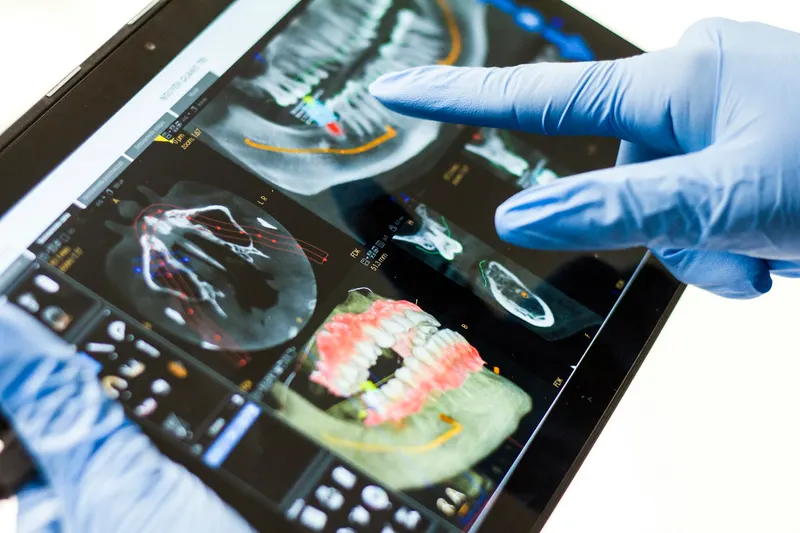
A 3D scan with iTero, X-rays and, if needed, other imaging tests.
03
Planning
A 3D simulation of the movement of each tooth and of the expected result.
04
Clear explanation
What can realistically be achieved, how long it will take, whether another specialist is needed and a no-obligation quote.
During treatment
The treatment, step by step
Before starting
Preparation
Any decay or gum problems are treated if needed and, if the case requires it, the plan is coordinated with other specialists.
Start
Fitting
The attachments are placed and you receive your first aligners with instructions for use.
Every 6 to 8 weeks
Check-up
Dr Ruiz checks that each movement is going as planned and adjusts whatever is needed.
If needed
Final adjustment
In complex cases a new scan and a series of aligners to fine-tune the result are common.
At the end
Retention
The attachments are removed and retainers are fitted to keep the result.
Tools
What is used in difficult cases
To guide movement
Attachments
Small tooth-coloured bumps that help the aligner push in the right direction. They are removed at the end.
To correct the bite
Elastics
Small rubber bands between the upper and lower aligners that help the two arches fit together.
To gain space
Interproximal reduction
A very thin layer of enamel is polished between some teeth to make room without extracting any. It does not hurt.
When the case requires it
Other specialists
Periodontist, maxillofacial surgeon or restorative dentist, coordinated from the start.
Comparison
Simple case and complex case: what changes
The system is the same. What changes is how much planning is needed and which tools are used.
| Simple case | Complex case | |
|---|---|---|
| Duration | Usually a few months. | Around 12 to 30 months, depending on each case. |
| Diagnosis | Scan and examination. | Scan, X-rays and sometimes other tests. |
| Tools | Aligners and sometimes attachments. | Attachments, elastics and interproximal reduction if needed. |
| Final adjustment | Not always needed. | A refinement series is common. |
| Other specialists | Not usually needed. | Sometimes, coordinated with the doctor. |
Results
Real cases by Dr Ruiz
Photos of patients published with their permission, with the same framing before and after. Every mouth is different and the result depends on each case.
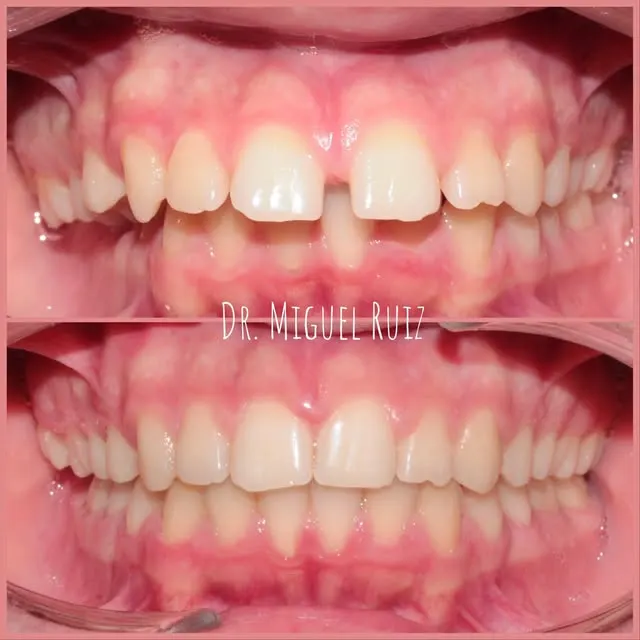
Scissor bite
Top before, bottom after
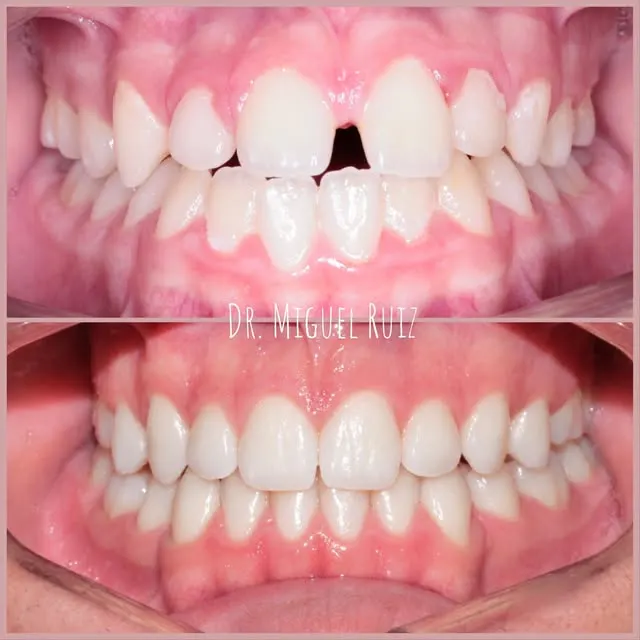
18 months of Invisalign
Top before, bottom after
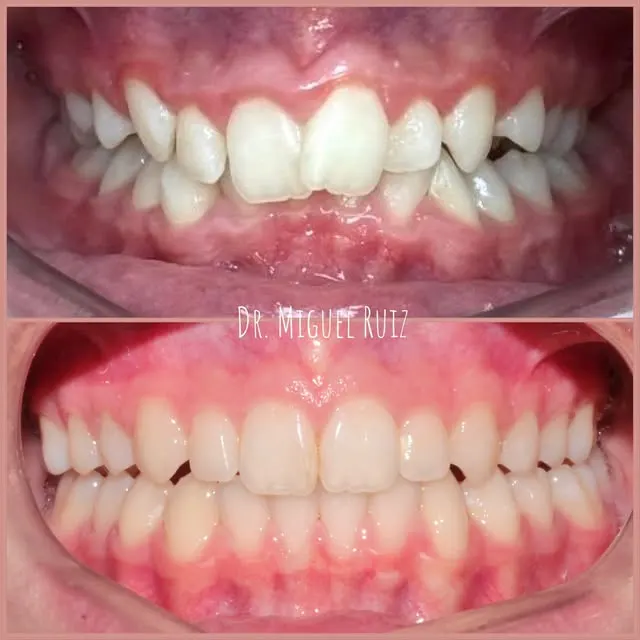
15 months of Invisalign
Top before, bottom after
Important information
What you should know
A complex case carries the same risks as any orthodontic treatment, with some particular points worth knowing:
- Treatment takes longer and may need one or more refinement series.
- Elastics only work if you wear them as the doctor tells you.
- Discomfort or pressure during the first days of each aligner.
- Shortening of the roots of a tooth, which is rare, as with any orthodontic treatment.
- When the problem lies in the bones, orthodontics alone may give a limited result.
- Teeth tend to move back if you do not wear your retainers.
Dr Ruiz will go through them with you at the first visit and they will be included in the informed consent.
Common questions
Frequently asked questions
I was told my case was not suitable for Invisalign. Can I get another opinion?
Yes. Dr Ruiz will assess your case and tell you clearly whether aligners are a good option or whether another treatment would suit you better.
How long does a complex case take?
Usually between 12 and 30 months, depending on the movements needed. You will have an estimate from the first visit.
Will I need surgery?
Only in some cases where the problem lies in the facial bones. If that is your case, the doctor will tell you from the start and coordinate it with the surgeon.
What are attachments?
Small tooth-coloured bumps bonded to some teeth so the aligner can move them better. They are barely visible and are removed at the end.
Does interproximal reduction hurt?
No. A very thin layer of enamel is polished and no anaesthetic is needed.
Is it as effective as braces in difficult cases?
In many cases it is, as long as it is well planned and you wear the aligners for the recommended time. In others, the doctor may recommend another option.
How much does a complex case cost?
It depends on what you need. At the first visit Dr Ruiz gives you a no-obligation quote.

Your orthodontist
Dr Miguel Ruiz
Orthodontist in Madrid, focused on clear aligner orthodontics for adults and children, with a large part of his work in complex cases. He sees you personally at the first visit, during treatment and at every check-up.
“Architect of smiles”
Consultations at Príncipe de Vergara 97, Madrid